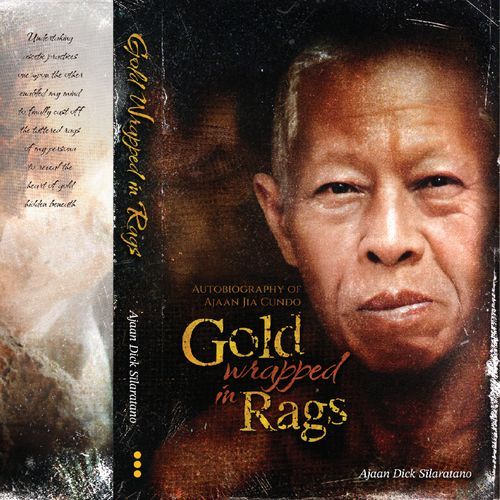
8. Seeds... Chapter 7 of 'Gold Wrapped in Rags: Autobiography of Ajahn Jia Cundo'
Audiobook: Gold Wrapped in Rags — Autobiography of Ajahn Jia Cundo
Episode · 0 Play
Episode · 1:11:48 · Jan 9, 2025
About
Ajahn Mun and I spent two consecutive rains retreats at Non Niwet Monastery in Udon Thani. Following the second retreat, a delegation of lay devotees from neighboring Sakon Nakhon province came to visit Ajahn Mun. After exchanging heartfelt greetings, they expressed a fervent wish that Ajahn Mun consider moving to Sakon Nakhon to take up residence in the province for the spiritual benefit of the Buddhist faithful there. When he agreed, the delighted visitors quickly set about making travel arrangements. As usual, I accompanied him on the journey. By that time, I’d been Ajahn Mun’s personal attendant for two full years. Upon our arrival at Sakon Nakhon in late 1941, Ajahn Mun and I were escorted to Suddhawat Monastery in the provincial capital. Soon, crowds of monks and laity were packing the Dhamma hall, eager to pay their respects and seek his advice. Several days after we arrived at Suddhawat Monastery, Ajahn Mun received a correspondence from his friend and mentor, Ajahn Sao Kantasīlo, who wrote asking Ajahn Mun to visit him in Ubon Ratchathani province because he had fallen gravely ill. Reluctant to make the long trek to Ubon himself, Ajahn Mun entrusted me to go on his behalf to attend to Ajahn Sao’s needs and nurse him back to good health. I was to inform Ajahn Sao that, with all due respect, Ajahn Mun had sent me to be his attendant. When Ajahn Mun instructed me to take special care of Ajahn Sao, he stressed that even if his symptoms abated, I was not to trust that he was cured. He reminded me that Ajahn Sao would be eighty-two years old soon, and his health had been on the decline for some time. I immediately took off on foot for Ubon. With my umbrella-tent slung over one shoulder and my bowl hanging from the other, I trekked south along forest tracks that passed through mountain ranges thick with dense foliage, where small settlements were often a day’s walk apart. After two weeks of hiking, I finally arrived at Ubon and found Ajahn Sao recuperating at Dawn Taat Monastery in the Piboon Mangsahaan district. The cause of Ajahn Sao’s symptoms was a severe allergic reaction. While Ajahn Sao sat meditating under a large rubber tree one afternoon, a hawk happened to swoop down through the overhead branches to snatch its prey. By some twist of fate, the hawk’s wing collided with a beehive suspended from a branch high up in the tree. Suddenly dislodged, the hive crashed to the ground and split open a few feet from where Ajahn Sao sat. The agitated bees swarmed his body and stung him repeatedly. While under attack from all directions, Ajahn Sao managed to crawl under a nearby mosquito net, after which the bees gradually dispersed. It was a reaction to the bee stings that had caused Ajahn Sao’s acute condition. When I arrived, Ajahn Sao’s skin appeared flushed, his throat and tongue were swollen, and he had difficulty breathing. Additionally, he suffered bouts of dizziness and felt unsteady on his feet. I immediately went to work trying to relieve the most severe symptoms, but despite my efforts his condition only seemed to worsen. Using my fingernails, I scraped out a few stingers that remained embedded in his skin. To relieve the persistent redness, pain, and swelling, I crushed handfuls of soothing forest herbs and applied them to his body as a poultice to reduce the inflammation. After several days, the swelling and the skin discoloration subsided, and I eventually managed to nurse Ajahn Sao back to health. Dawn Taat Monastery was a fifty-acre plot of land situated in the middle of the Moon River. The island monastery was the first monastery built by Ajahn Sao. Local farmers had previously planted rice on the island’s low-lying land near the water’s edge but had left the hilly, forested interior alone. Impressed by the island’s seclusion, Ajahn Sao crossed over and began meditating on the island’s forested hills. Before long, the villagers who supported him with alms food had developed such strong faith in Ajahn Sao that they offered him their low-lying fields as a site to build a monastery, thus turning the whole island into a residence for monks. Originally, the local villagers had called the island Dawn Taak, or Leech Island, because the damp forest floor was teeming with leeches. The villagers were bitten by hordes of leeches whenever they entered the forest to look for wild vegetables and medicinal plants. After Ajahn Sao took up residence on the island, however, the locals changed its name slightly to Dawn Taat—taat meaning “holy relic.” Ajahn Sao told me that before arriving at Dawn Taat, he had wandered continuously from place to place, spending nights camping in rural rice fields and pastures, sometimes taking shelter inside rice barns or under large, shady trees. Before the sun set below the horizon each day, he would have already found a place to hang his umbrella-tent and spend the night. When he first reached the area around Dawn Taat, he camped under a large khor tree near Dawn Phanchaat village. The monks accompanying him set up their umbrella-tents in a woodland area nearby. Ajahn Sao told me a strange story about the large flock of crows that lived in the branches of that khor tree. The whole flock exhibited abnormal behavior. They flew over and around the big tree where he camped all day, making raucous cawing sounds from dawn to dusk. The local villagers didn’t dare take any action against them because they believed that the crows belonged to the guardian spirit that lived in the tree. They were terrified that, if they harmed the crows, the powerful spirit might curse them and cause them misfortune. For his part, Ajahn Sao saw the crows as companions in birth, aging, sickness, and death. Out of compassion, he began feeding them the leftover food from his alms bowl every morning. Soon, the crows became especially attached to him...
1h 11m 48s · Jan 9, 2025
© 2025 Podcaster