Not Every Failure Counts Against You - MAC158
Episode · 0 Play
Episode · 18:12 · Sep 15, 2026
About
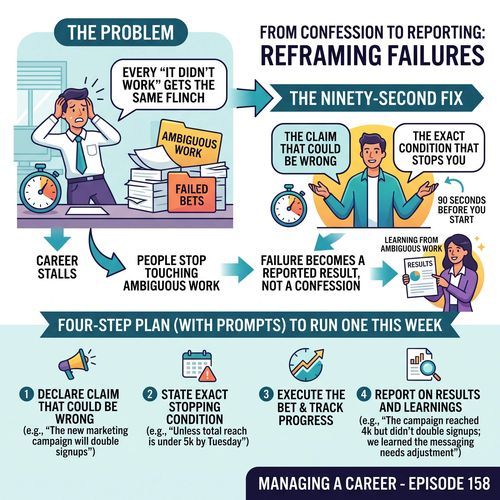
Two people walk out of two different meetings having heard the same sentence: it didn't work. One of them skipped a step in a process the company has run four hundred times. The other tried something the company has never tried. Same sentence, same tone in the room, same quiet adjustment in how each of them gets described in the next talent review.That's the problem underneath this whole piece: your organization almost certainly cannot tell those two people apart. Not because anyone up the chain is cruel — because sorting the difference is genuinely hard and the meeting has twenty minutes. That failure to sort is expensive in a very specific, very avoidable way, and there's a fix that costs about ninety seconds and changes the entire conversation.Three kinds of wrongBefore any of this is useful, the terminology has to be exact. Amy Edmondson, a Harvard Business School researcher who has spent a career studying how organizations handle things going wrong, lays out three distinct kinds of failure, and argues they need opposite responses.A basic failure has one cause, is usually preventable, and happens in territory that is completely known — the invoice with last quarter's numbers, the wrong client name in the deck, the checklist step skipped because the day ran long. There's no mystery and no glory here. A basic failure needs a system, not a lesson.A complex failure happens when several things go wrong at once and no single one of them would have caused the problem alone — the vendor slips a week, the reviewer is on leave, the requirements quietly changed in a meeting nobody wrote down. You don't eliminate complex failures. You build slack and make the pieces visible to each other.And an intelligent failure is the one nobody teaches. Edmondson sets four conditions for it: it happens in genuinely new territory where no playbook exists; it's a credible route toward something that matters; it's informed by what you already know, not a wild swing; and it's kept as small as possible while still teaching you something.An intelligent failure isn't a mistake. It's the price of information you couldn't have bought any other way.I want to sharpen something I said in an earlier episode, Own Your Mistakes, Deliver Results (MAC-149). I stand behind most of it, but I treated "your mistake" as one category — a thing you step toward, own cleanly, and move past. What I missed is that a good chunk of what gets called your mistake was never a mistake at all. It was a bet. And owning a bet the way you'd own an error isn't integrity — it's a filing error, and you're the one who filed it.Here's the distinction: a mistake is something you should have known. A bet is something nobody knew. Notice that has nothing to do with the outcome — both end in it didn't work. The difference sits entirely in what was knowable beforehand, which is exactly the information that disappears the moment the result is on the table.The lane nobody is driving inMost organizations respond to all three kinds of failure identically — not from cruelty, but because sorting them is slow and the meeting is short. So the org reacts to the outcome, the one piece of information everybody already has. Basic, complex, intelligent — same flinch, same footnote in the calibration room. I covered where that instinct goes once it's left alone in The Blame Game (MAC-099); what's happening here sits one step upstream of blame, in the sorting that never occurs in the first place.People learn fast, and what they learn isn't "don't be careless." It's "don't be the person standing next to the uncertain thing." They stop volunteering for the ambiguous project. They stop floating the idea that would need a real test. I've watched this happen to people who were, on paper, the strongest performers in the room. None of them decided to become conservative — they just took the only signal the system was actually giving them: unpredictability is expensive.That produces an empty lane. Almost everyone in your organization competes in the same place — flawless execution on known work — because that's where the incentives point. Meanwhile the genuinely ambiguous projects go undersubscribed year after year, carrying a risk everyone has correctly identified and nobody has learned to manage.Everyone wants the person who takes smart risks. Almost nobody wants to be the person mid-risk. That gap is the opportunity, and it's not because risk-taking is inherently virtuous — plenty of people have torched a career on a wild swing they couldn't explain afterward. It's that the skill of running a bet well is rare, visible when present, and almost never taught. Being the person who can take the ambiguous project and give leadership a clean account of it either way is a method, not a personality trait — and the method is learnable.There's a line I keep returning to on the show, from Seneca: luck is what happens when preparation meets opportunity. I built an early episode around it in A Little Bit of Luck (MAC-013), and returned to it in Posting Publicly (MAC-144) and Manufacturing Serendipity (MAC-147). In those episodes, the missing half was almost always opportunity — people preparing in private and waiting for a door to appear. Here the equation inverts. The opportunity is already staring you in the face: the empty, ambiguous project everyone else is avoiding. Standing next to it without the right preparation doesn't make you lucky — it makes you exposed. The preparation that matters here isn't another title or another hour of overtime. It's learning to run a bet cleanly, so that what looks like a lucky break to everyone else in the room is just preparation meeting the door nobody else opened.There's a habit worth building alongside this. A Princeton professor once published what he called a CV of failures — the grants he didn't get, the papers rejected, the jobs he didn't land — and it traveled further than his actual research. The venture firm Bessemer keeps a public version, an "anti-portfolio" of the enormous companies they had a chance to invest in and passed on.Keep your own private version. If you already keep the brag document from MAC-141 or the prevention ledger from MAC-155, this is one more column in the same file: what you bet, why it was reasonable at the time, what it cost, and what you now know that you couldn't have known any other way. The brag document records what worked. The prevention ledger records what never broke. This one records what you were willing to find out.The stated betNone of the above protects you on its own. Here's the mechanism, and it's smaller than you'd expect: the reason a bet gets processed as a mistake has almost nothing to do with the bet. It has to do with when you described it.Picture the version most people run. You believe something will work, you spend six weeks on it, it doesn't work. Now you're standing in front of your manager explaining that this was always exploratory, that the outcome was uncertain, that you learned a lot. Every word might be true. It doesn't matter — you're saying it after the result, so it arrives as a defense, and a defense carries the smell of the thing it's defending against.Run the same six weeks with one difference. Before you start, on the record, out loud, to whoever would have to approve it, you say: here's what I think is true that nobody here has tested, here's what result would tell me I'm wrong, here's when I stop. Six weeks later, the identical failure — but what you're delivering is not a defense. It's the answer to a question you both agreed to ask.That's the whole move. I call it the stated bet, and the entire mechanism is sequence. Said afterward, it's an excuse. Said beforehand, it's a method.Two pieces go into it. The claim: what you believe that isn't currently known, stated plainly enough that it could turn out to be wrong. "I think we're losing most of these renewals in the first two weeks, not at the contract date" is a claim. "I'd like to explore the renewal process" is not — it can't fail, which means it also can't teach you anything, and your manager can feel that even without naming it.The stop is the piece people skip: what result, or what date, ends this. A stop condition feels like planning to lose, but it's what makes the whole thing affordable. Edmondson's fourth...
18m 12s · Sep 15, 2026
© 2026 Libsyn